
The Enterprise Blueprint: Navigating End-to-End Salesforce Consulting Solutions
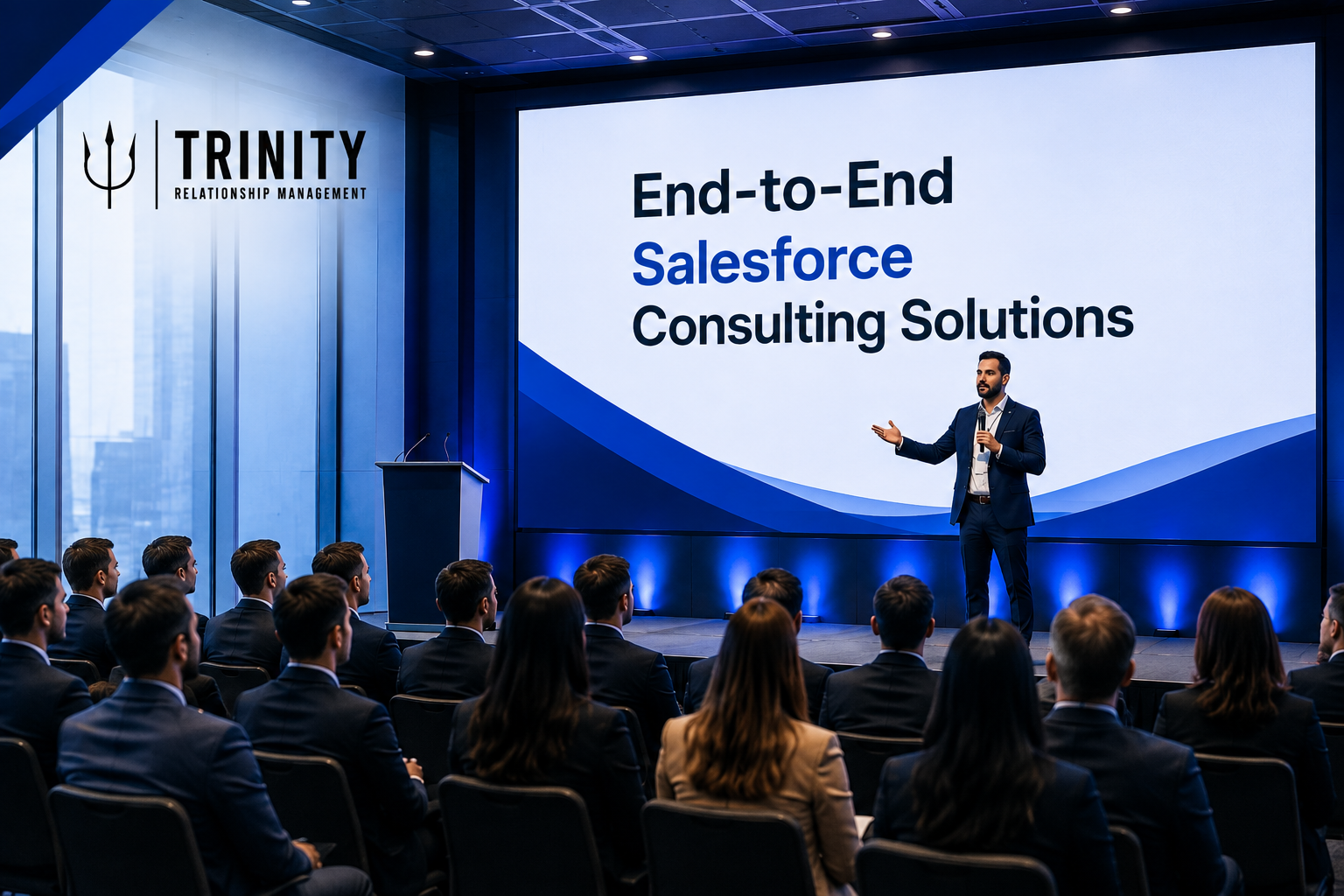
End-to-End Salesforce Consulting Solutions presented in a professional corporate conference setting, highlighting strategic Salesforce consulting, enterprise CRM solutions, and business-focused technology expertise.
Most enterprise buyers still treat Salesforce as a glorified spreadsheet. They configure a few pipelines, automate a handful of tasks, and call the deployment complete.
That mindset misses the point entirely. Modern platforms demand integrated, ambient data layers, not siloed workflows bolted together for a single department's convenience.
End-to-end Salesforce consulting solutions solve exactly this problem, separating durable enterprise architecture from expensive digital clutter. The distinction shows up fastest in how a partner approaches discovery, governance, and long-term system evolution.
Table of Contents
Beyond Simple Configuration: The Core Pillars of a Complete Strategy
Maximizing Multi-Cloud Assets: The Automation Framework
Vetting Strategic Partners: Operational Benchmarks for Enterprise Tech Buyers
Defeating the Adoption Trap: Sustaining Long-Term Platform Governance
Conclusion
Frequently Asked Questions
Beyond Simple Configuration: The Core Pillars of a Complete Strategy
Three disciplines separate a resilient build from a fragile one, and each starts before a single object gets configured.
Strategic Discovery and Data Mapping
Authentic engineering begins with discovery sessions mapping every data source, ownership boundary, and downstream dependency, well before any flow gets built. Skip this and technical debt accumulates quietly: a poorly mapped data model looks fine at launch, then buckles when a new business unit or acquisition arrives.
Cross-Cloud Architecture in Practice
Front-end sales pipelines must align with back-end ERP data, inventory, and finance ledgers, so revenue reporting reflects reality. Consider a distribution company merging Salesforce with an ERP platform. Without a proper integration layer:
Sales reps close deals the warehouse can't fulfill
Fulfillment teams work from outdated stock counts
Finance reconciles conflicting versions of the same order
That discipline separates genuine end-to-end Salesforce consulting solutions from a patchwork of disconnected point tools.
Governance as Infrastructure, Not Paperwork
Governance is the third pillar, and it's chronically underbuilt. Elite architects build field-level permissions tied to actual job functions, automated guardrails blocking corrupted records before production, and change management that survives staff turnover and platform upgrades.
A top Salesforce consulting firm treats these guardrails as infrastructure, not documentation nobody reads after go-live. Buyers who skip this criterion inherit brittle systems within eighteen months.
Maximizing Multi-Cloud Assets: The Automation Framework
Nowhere does that spend-versus-capability gap show up more starkly than in the marketing stack.
The Campaign Execution Drain
Companies license powerful marketing architecture, then use it for manual email batching that a cheaper tool could handle. Call this the Campaign Execution Drain: Enterprises pay premium fees for Salesforce Marketing Cloud, then run static blasts instead of dynamic, behavior-driven journeys.
Behavioral Journeys and Real-Time Personalization
Real strategic depth requires behavioral journey builders reacting to live signals: browsing patterns, cart abandonment, support tickets, and purchase cadence.
Fragmented identity resolution is the silent killer of deliverability: duplicate profiles trigger redundant sends that damage sender reputation. A properly architected Salesforce Marketing Cloud instance treats identity resolution as a first-class engineering problem, not an afterthought.
Unifying Audience Data Across Clouds
Top Salesforce consulting services build unified profiles that synchronize across Sales Cloud, Service Cloud, and Salesforce Marketing Cloud in near real time, often recovering six figures in wasted send volume annually.
Once inbox providers flag a domain for low engagement, recovery takes months of disciplined list hygiene and rebuilt sender trust. This depth of automation separates a genuine top Salesforce consulting firm from an agency that simply resells Salesforce Marketing Cloud licenses. The best Salesforce consulting services providers monitor engagement and adoption weekly, not annually.
Vetting Strategic Partners: Operational Benchmarks for Enterprise Tech Buyers
Spotting a capable partner from an average one comes down to a few concrete, checkable signals.
Discovery Protocols and API Approach
A standard staff-augmentation agency bills hours and executes tickets. An elite partner builds systems that outlive them, the core promise behind end-to-end Salesforce consulting solutions. Augmentation vendors ask which objects need building, while genuine top Salesforce consulting firm partners ask which outcomes justify the build.
Average providers hardcode point-to-point API connections that break with every release. Stronger partners design middleware layers that absorb API changes without cascading failures.
Success Metrics That Actually Matter
Staff-augmentation vendors report hours billed and tickets closed. Elite partners report user adoption rates, data quality scores, and measurable revenue impact tied to the deployment.
Three Questions to Ask During a Pitch
Enterprise leaders should ask three pointed questions during any pitch:
How does your team handle API version deprecation across a three-year roadmap without service interruption?
What is your methodology for reconciling duplicate records across Sales Cloud and Salesforce Marketing Cloud during a merger?
Can you show a documented framework for measuring adoption beyond simple login counts?
Weak answers eliminate most average bidders before a contract gets signed. Buyers evaluating top Salesforce consulting services should request a reference client with a comparable data footprint, since complexity scales with data volume, not company size.
Defeating the Adoption Trap: Sustaining Long-Term Platform Governance
Most platform failures trace back to the same blind spot, one that surfaces long after the invoice is paid.
Why Post-Launch Failure Happens
Deployments rarely fail at launch. They fail eighteen months later, when the original champions leave and nobody remembers why certain automations exist. End-to-end Salesforce consulting solutions face their hardest test here, since role-based training gets treated as a rollout checkbox, then abandoned. New hires inherit an unexplained system and improvise workarounds in spreadsheets. Top Salesforce consulting services close this gap through structured, role-specific onboarding built into the rollout plan.
Building Adoption-Tracking Frameworks
Elite partners embed adoption-tracking frameworks into the platform from day one. Dashboards surface login frequency by team and role, feature usage against licensing, and data entry compliance, turning governance from a reactive fire drill into a continuous discipline.
Making Governance a Contractual Deliverable
A top Salesforce consulting firm builds these governance dashboards as a contractual deliverable, not a courtesy add-on offered after the invoice clears.
End-to-end Salesforce consulting solutions succeed because they treat platform health as an ongoing operational metric, equal in weight to pipeline velocity or campaign conversion. Top Salesforce consulting services extend this discipline past go-live, revisiting adoption data quarterly. A genuine top Salesforce consulting firm never treats launch day as the finish line.
Conclusion
Technical execution only matters when it serves measurable business growth. A perfectly configured org that nobody adopts delivers zero return.
Enterprise leaders should audit platform health now, before another year of technical debt and wasted marketing spend sets in. The strongest end-to-end Salesforce consulting solutions treat that audit as a starting point, not a finish line.
Don't let disconnected systems, poor adoption, or technical debt limit your Salesforce investment. Trinity CRM delivers end-to-end Salesforce consulting solutions that help enterprises build scalable, future-ready CRM ecosystems. Ready to build a Salesforce ecosystem that scales with your business? Connect with Trinity CRM to discuss your goals and discover how a strategic, end-to-end Salesforce consulting approach can deliver long-term business value.
Frequently Asked Questions
How soon does adoption data become measurable after a proper enterprise rollout?
Deployments with strong discovery and governance built in typically show adoption gains within two to three quarters, ahead of full ROI reporting cycles.
What actually separates Salesforce Marketing Cloud from Sales Cloud in an integrated deployment?
Marketing Cloud manages behavioral journeys and audience segmentation. Sales Cloud tracks pipeline and account data. A unified identity layer keeps both synchronized without duplicate records.
How much should enterprises budget for governance after go-live?
Mature deployments typically allocate ten to fifteen percent of the original implementation cost annually toward governance, training, and adoption monitoring.
At what point does an in-house admin stop being enough?
Once an org passes roughly 200 licensed users or spans more than two clouds, complexity usually outpaces what one admin can safely govern alone.